
Badger badger badger badger badger badger badger badger - mushroom, mushroom.
If you know, you know. If you don't, congratulations: you've just discovered a piece of internet history. That was Badger Badger Badger, a Flash animation from 2003 by Jonti Picking, also known online as Weebl. It's exactly what it sounds like: animated dancing badgers, mushrooms, a sneaky snake, and a looping song that will live inside your head rent-free forever. It has no point. It serves no purpose. It contains no message, no call to action, no monetisation strategy. It just is.
And yet it was one of the most widely shared things on the internet back in 2003.
Nobody optimised it. Nobody A/B tested thumbnails for it. Nobody iterated on the hook. Someone just made a strange, delightful thing, put it online, and people passed it around like crazy because that's what you did with strange, delightful things. That was the deal the early internet offered, in exchange for nothing.
I think about that sometimes. About what we traded it all in for.
The Playground
There was a specific kind of afternoon in the early 2000s. You'd get home from school, open the family computer, navigate to Newgrounds or Albino Blacksheep or some link someone had forwarded you by email or MSN (this was way before social media) and you'd just see what was out there. You didn't know what you were going to find. That was the point and it was glorious.
Newgrounds launched in 1995 and by the early 2000s it was a vast, chaotic, barely-moderated treasure trove of Flash animations, games, and things that defied easy categorisation. The submission guidelines were famously minimal. What emerged from that freedom was also wildly unpredictable. Early work from animators and developers who would go on to build entire studios like Edmund McMillen of Super Meat Boy fame, the Behemoth who made Castle Crashers, all came up through Newgrounds. Not because Newgrounds was designed to nurture talent. It certainly wasn't. It was however designed to host whatever people made. The talent emerged as a side effect of creative freedom.
That's the thing about playgrounds. You don't go to a playground to achieve something. You go to mess around. And messing around, done long enough, occasionally produces something extraordinary.
What Flash Actually Was
Adobe Flash gets a complicated obituary. On one hand: security vulnerabilities, performance problems, Apple famously refusing to support it on the iPhone. On the other hand, for about fifteen years, Flash was the single most creative tool the internet had ever seen. You could learn it with a pirated copy and a tutorial. You didn't need a studio, a budget, or a degree. You just needed curiosity and time. And what people made with it was genuinely unlike anything before or since. Interactive art, weird games, experimental animation, strange little browser experiences that asked nothing of you except a click.
The key word here is interactive. Flash didn't just produce content to watch. It produced things to participate in. You weren't a viewer. You were a player, a clicker, a person inside the thing.
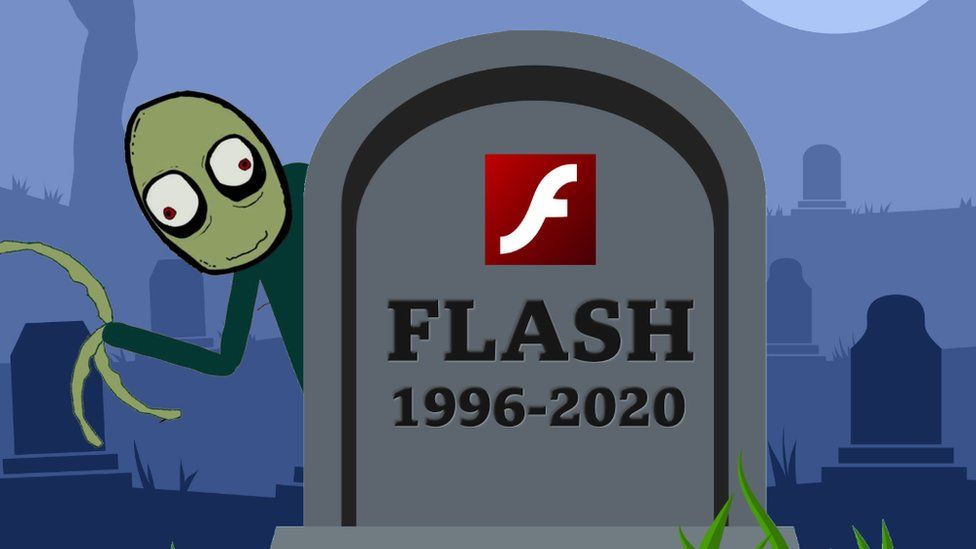
Flash died on the 31st of December 2020. Adobe quietly ended support, browsers blocked it overnight and something irreplaceable went with it. The animations survived, mostly. People converted them to video files, uploaded them to YouTube, archived them. You can still watch Badger Badger Badger. The Flashpoint Archive has preserved hundreds of thousands of pieces of Flash content through an heroic volunteer effort.
But the games? The interactive experiences? They're largely gone. A video can become an MP4. A game can't become a video without becoming something entirely different like a recording of someone else playing, which isn't the same. The interactivity dies with the format.
That's not just a technical problem. It's a philosophical one. The old web wasn't just something you watched. It was something you did. And we lost the ability to do most of it as the technology moved on.
The Texture of the Era
The thing that keeps coming back to me about those years is how aimless it all was. In the best possible way.
MySpace let you customise your profile page with HTML/CSS (badly I might add) and usually in ways that completely broke the entire layout. But underneath the chaos was a genuine act of self-expression. Your page looked like you, not like a template and that was the point. LiveJournal had people writing long, earnest, unpolished essays about their lives, fandoms and feelings. Not for an audience. Not for a brand. Just because they had something to say and somewhere to say it.
Tumblr, in its early years, was one of the strangest creative spaces the internet ever produced. A place where fandom, art, humour and politics collided without any particular logic or reason, mixing together the blender of culture. Vine gave people six seconds, a camera and no monetisation strategy. Just go to something stupid. What people made with that constraint still still lives on years later in YouTube compilations. Six seconds is almost nothing, and yet the creativity it forced out of people was remarkable. Constraints, it turns out, are where invention lives.
None of these platforms were efficient. None of them optimised. They were messy, in the way that real humans are messy. And in among that mess, people found each other, found themselves, and occasionally made something that mattered. What they had in common was that the platform didn't have an agenda for you. It gave you a space. What you did in it was your problem and your privilege.
The Hinge
There's a temptation to frame this as a nineties-versus-now story. The golden age against the present. I don't really think the dividing line was a decade though. I think the true dividing line is the algorithm getting smart enough to work against you.
Early recommendation systems were stupid. YouTube in 2006 showed you more videos from the same uploader, or whatever had the most views this week. Simple stuff. That's not much different from a "you might also like" shelf in a record shop... a suggestion, not a rule. You could ignore it. The machine didn't know you well enough to manipulate you... yet.

That changed somewhere around 2012 to 2016. Recommendation systems got genuinely intelligent. Intelligent enough to build a model of you more accurate than the one you carry around in your own head. Intelligent enough to know that content which makes you anxious keeps you scrolling longer than content that makes you happy. Intelligent enough to exploit that, systematically, at scale. This is the moment the playground became a platform. Not because anyone announced it. Not because the interface changed noticeably. But because the purpose changed from hosting what you made to extracting what you'd give.
Tumblr got bought by Yahoo in 2013. That's roughly where its decay began. Vine was shut down by Twitter in 2017, unable to find a way to make money that satisfied shareholders. Apparently, six seconds of creativity as it turns out was hard to sell advertising against. Instagram, which once felt like a playground for photography, became a commerce engine with a photo app attached. The container changed. The behaviour followed.
The Playground Impulse Doesn't Die
Here's the thing though: it doesn't die. It relocates.
Newgrounds is still there. Still running. Still hosting animations and games made by people who want to make things with no particular agenda. Itch.io became the Newgrounds of indie games offering a platform explicitly built on the principle that weird, experimental, uncommercial work deserves to exist. You can pay what you want, or nothing. The catalogue is enormous and strange and full of things that would never survive a pitch meeting at a publisher.
And then there's VRChat. I film inside VRChat, which means I get to see first hand what happens when you give people creative tools and no real agenda. People build worlds that serve no commercial purpose. They dress as creatures that have no marketing team. They gather in spaces that exist purely because someone wanted them to exist. The economy of clout and metrics that governs most online spaces has a much weaker hold here, not because VRChat is perfect, it isn't, but because the medium resists easy extraction. You can't scroll VRChat. You have to be somewhere. That friction is the point.
The playground impulse, the need to make something for no reason, to gather somewhere without an agenda, to exist online in a way that isn't performing for an algorithm... that impulse is still alive in people. It didn't get optimised out of us. We just had to find smaller, weirder, less profitable corners of the digital world to express it.
What We Actually Lost
I want to be honest about what was wrong with the old internet, because I think the nostalgia becomes a lie if we're not.
The early web was slow, inaccessible, technically hostile. The kid-oriented spaces many of us remember fondly had their own predatory mechanics. VIP memberships that bullied free users, moderation failures that let bad actors in. Flash was a security nightmare. The freedom that produced Newgrounds also produced content that absolutely nobody should ever see. These things were real.
But what we actually lost wasn't the imperfection. It was the orientation. The early internet's primary question was: what do you want to put here? The modern internet's asks: what will keep you here the longest? Those are not the same question, and they produce entirely different spaces and entirely different people.

When failure has no consequences, you experiment. When every post has a like count, a share count and contributes to your follower number, you don't experiment, you optimise. You get rid of the cringe, the weirdness, the personality. You make content that looks like every other piece of content that "worked" or went viral. What gets filtered out isn't the bad content. It's the strange, the unpolished, the enthusiastic, pointless content. The Badger Badger Badger content.
One of the things those old spaces got right is that they let people fail publicly without permanent consequence. There was no searchable feed of old posts. No engagement metric that followed you into adulthood. You could be weird and wrong and embarrassing and it just dissolved. We now have an internet that never forgets and everything follows you. And yet we're still surprised that people are less willing to try things. Go figure.
The Small Rebellions
The badgers are still out there. Not those specific badgers (though you can still watch them) but the impulse that made someone sit down and make a looping animation about badgers and mushrooms for no reason except that it seemed funny. That impulse is still alive. The shit posting lives on.
It's in the person maintaining a Neocities page about their obsession with obscure rail history. It's in the itch.io developer releasing a game about sorting hats that maybe forty people will ever play. It's in whoever is currently building the strangest VRChat world you haven't found yet. It's in the Flashpoint Archive volunteers who spent years preserving hundreds of thousands of pieces of digital culture that nobody was paying them to save.
These aren't big things. They exist at the margins of an internet that has mostly been monetised into submission. But they matter for the same reason the old playgrounds mattered: they are made by people who wanted to make something, for no better reason than that.
The enemy was never technology. It was the incentive structure imposed on technology. And incentive structures are not laws of nature. They are decisions made by people, which means they can be unmade, or worked around, or simply ignored by the stubborn minority who'd rather make something strange and share it freely than perform for an algorithm that doesn't know their name.
Somewhere on the internet right now, someone is making something genuinely weird. They haven't thought about the audience. They haven't thought about the engagement rate. They just have a thing they want to make, and a browser, and time.
That's a playground. Go find it.