
I still remember the sound of connecting.
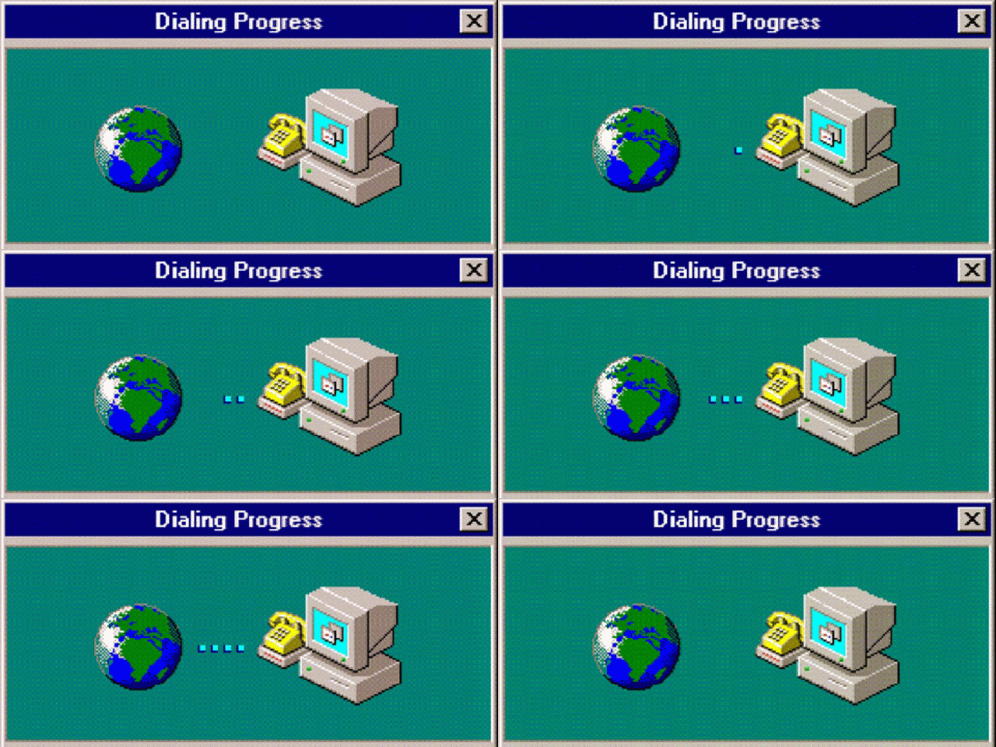
There was a ritual to it. You'd pick up the phone, check nobody needed it or was expecting a call, then click dial and wait. What happened next was extraordinary. A symphony of electronic shrieks and handshakes, two machines negotiating terms of a conversation across miles of dubious copper wire that was never meant for any of this. My father called it "angry robots screaming" whenever he picked up the phone by accident. He wasn't wrong. And then, after all of that you were finally online.
Growing up in rural Ireland in the late nineties, the internet arrived late, slow and of course came rationed. Thirty hours a month. You had to made choices. You planned what you wanted to look at. You didn't scroll out of habit, you saved to disk and moved on. Every minute was deliberate. The internet was not ambient background noise or a casual stroll, it was an event you showed up prepared for.
I was ten years old when I first understood what it actually was. Not a phone service. Not a weird TV channel. Something much more like a library built by everyone, organised by nobody, with no closing time and no librarian to ask if you were supposed to be in this section. You could just wander freely. Anything could be around the next link and every page was a hand crafted dedication to a passion project, personal interest or often just somebodies cat.
I loved it immediately.
A Web Nobody Owned
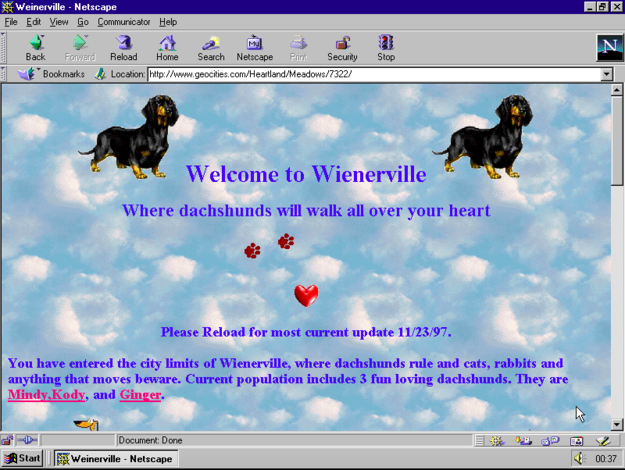
The term that gets used most often for the internet of the late nineties is GeoCities, and for good reason. Launched in 1994, it gave anyone with an email address a small plot of digital land and the tools to build on it. By the time I finally stumbled across it, there was a vast 38 million pages organised into themed neighbourhoods. You weren't just a URL. You were a resident of SiliconValley or Athens or Heartland, and that neighbourhood affiliation told visitors something about who you were before they'd even read a single word. The pages themselves were, by any modern design standard, a catastrophe. Tiled backgrounds that made your eyes water. Animated GIFs that never stopped moving. Comic Sans sitting next to Impact sitting next to a font someone had clearly just discovered and committed their entire existence to using. Horrible loud MIDI music that started playing the moment you arrived, whether you wanted it or not. Spinning visitor counters. Under Construction banners. Marquee text scrolling across the screen on an infinite loop.

And somehow, genuinely, not ironically, it worked. Underneath the visual chaos and confusion was something the modern web almost entirely lacks: a human fingerprint. You could feel the person who built the page. Their excitement. Their obsessions. Their complete disregard for whether any of the content within was legible to strangers, because the strangers weren't really the point of it all. The point was in the making.
I built my first website at around age eleven or twelve, in Microsoft Word of all things, saved as an HTML file and uploaded via FTP to a free host I can no longer name or access. It was about time travel of all things. Watching Back to the Future on repeat for months had convinced me that temporal mechanics was a serious field worth exploring, and what better place than the infinite weird wide web. I posted my theories. I invited visitors to share their own. The responses I got were, in retrospect, exactly what you'd expect: a handful of crackpots and at least one person who tried to sell me a used flux capacitor via email.
Nobody came. Nobody cared. It didn't matter. The thing existed, and I had made it, and somewhere out there on a server I couldn't picture, it was sitting waiting for anyone who happened to wander past. That was enough for me.
The Grammar of the Old Web
What made the amateur web feel so different wasn't just the aesthetics, it was fundamentally the structure. The way you moved through it. The relationships between pages. A website back then was a discrete object. It had a beginning, a middle, and an end. This was partly enforced by brutal practical constraints: storage was capped (often at 15MB), and loading time on a 56k modem meant every image slid into existence line by painful line. Pages were necessarily finite. You could finish visiting somewhere. The immortal guestbook was there to mark the moment, a public ledger where visitors left a note to say: I was here, I saw this, I'm leaving now. It was a small ceremony. A way of making the visit real.
Between sites, you navigated by webrings, which were those modest chains of related pages with a little navigation widget at the bottom that let you hop to the next site in the ring or jump to a random one. There was no algorithm deciding what you should see next. There was just another person who'd signed up to the same ring as you, which meant they probably cared about the same things. Discovery was lateral, human, and entirely unpredictable.
I remember spending hours on webrings exploring Tesla coils, fringe physics and conspiracy theories about the Philadelphia Experiment. Eventually I found my way to the Temple of the Screaming Electron, a sprawling archive of text documents that covered technology, philosophy, hacking culture and a great many things a teenager probably shouldn't have been reading. There were no guardrails. There were no content warnings. You stumbled into things and had to find your own way back to solid ground.
The old web trusted you to be a person, even if you were twelve.
Learning by Breaking Things
One of the things the amateur web did almost accidentally was teach people. Not through courses or tutorials or overpriced subscriptions, but through curiosity and failure and the irritating fact that something wasn't working and you needed to understand why.
I started building pages in Microsoft Word. Then I looked at the source HTML it generated and discovered it was almost unreadably messy, full of unnecessary tags and Microsoft-specific nonsense that didn't need to be there. So I started cutting things out to see what happened. Then adding things in. Then, gradually, building things from scratch in Notepad. Nobody told me to do this. There was no lesson plan. There was just a thing I wanted to make and a growing understanding of how to make it.
Everything I learned in those dial-up years stuck, because I learned it through my own hands. Through trying. Through breaking something and having to figure out why it broke. That's a particular kind of learning that doesn't happen when the tools do everything for you. When you drag and drop into a template that's been pre-optimised for engagement, you never think about what's underneath and ultimately close the door on the very curiosity that could take you so much further.
I look at kids now and what I see is a different relationship with the internet entirely. Not worse necessarily, but narrower. The web arrives pre-assembled through apps designed to be used, not understood. You tap. You scroll. You consume. The decades of decisions that got us here are completely invisible. They see the world wide web through keyholes. We saw it from mountain tops.
What Killed the Amateur Web
GeoCities was shut down by Yahoo in 2009. Thirty-eight million pages, gone. The Internet Archive rescued some of it, but most of it, the fan theories, the hobbyist tutorials, the teenage time travel sites, the guestbook entries, the webrings, all vanished. Web historians have called it a digital Pompeii but in my mind it's closer to the burning of the Library of Alexandria. An entire layer of human expression, preserved briefly in servers and then deleted in a business decision.
The death wasn't just about one platform going under though. It was about a shift in what the internet was for. In the early years, the primary question driving things was: what do you want to put here? By the mid-2000s, the question had quietly become: what will keep people here the longest? The attention economy changed the incentive structure of the entire web. Platforms got better at hosting content, but in exchange they took ownership of the context. You weren't building a place; you were providing content to someone else's platform. Your creativity was the product. Their interface was the container. Their algorithm decided who saw it.
Templates made it easier to participate but narrowed the range of what participation looked like. Everyone's page started looking like everyone else's page. The human fingerprint got sanded off in the name of consistency and professionalism. The weird, the unpolished, and the lovingly obsessive got filtered out like noise, not by censorship but by the quiet pressure of metrics. Low engagement meant invisibility. Invisibility meant why bother.
The web got faster, more powerful, more accessible and somehow less interesting. What it gained in reach, it completely lost in personality.
The Ghost in the Machine
The amateur web didn't die though. Instead it went underground and back to its roots. Neocities launched in 2013 as a deliberate resurrection of the GeoCities spirit. Free hosting, no templates, full creative control, and an explicit rejection of algorithmic mediation. It's now home to nearly 400,000 sites, and browsing it is one of the stranger experiences the modern internet has to offer. Pages about horror games and frogs and Y2K and cheese. Personal galleries and zine archives and portfolios for artists who have no interest in Instagram or fitting in. One user, when describing why they opted out of search engine indexing, put it simply: "We're skirting the deep web. It's the opposite of SEO."
The IndieWeb movement has been making the same argument in more structural terms and has put forward a philosophy for the new web. They believe that your domain should be your primary identity online, that you should own your content rather than rent space on someone else's platform and that publishing on your own site first is an act of digital self-determination.
And the webrings are making a come back. Under names like the yesterweb and the folk internet, communities are manually building the same rings of related sites that connected hobbyists in 1998. Not because it's technically superior (it obviously isn't), but because what it represents is. Human curation. Chosen connection. Discovery that happens because a person decided to put two sites next to each other, not because an algorithm calculated the probability of engagement. These are small things. They exist at the margins. But they matter for the same reason the time travel site mattered. They are made by people who wanted to make something, for no other reason than that. I can't think of anything more human.
The Screen That Was Yours
I eventually moved on from dial-up. ADSL arrived and suddenly the internet was always on at home and that changed everything. The way you used it, the way you thought about it. No more rationing. No more ritual. No more deciding in advance what you wanted to look for. I'm not sure I understood fully what I was trading away.
The internet I grew up with was imperfect in all ways that mattered. It was slow. It was technically hostile to anyone who didn't want to learn. It had no guardrails, which occasionally meant you ended up somewhere you wished you hadn't. It was no place for children but somehow like taking the training wheels off early, it helped us grow and learn, yet respect it like a naked flame.
It was ours, in a way the modern web is not. The pages were handmade. The connections were chosen. The human beings behind them were visible in every tiled background, broken image and enthusiastic MIDI file that started playing when you arrived. You could feel that someone had sat down, worked out how to do something, decided it was worth doing, and done it, for no audience, for no algorithm, just because they had a thing they wanted to share and the internet was, improbably, a place where you could do that.
That spirit isn't entirely gone. It's running on Neocities and personal domains and hand-coded pages and webrings that nobody outside the community has ever heard of. It's in everyone who still makes something and puts it somewhere online without optimising it first.
The angry robots are quiet now. The line is always open. But somewhere out there, someone is still building a time travel site that nobody asked for, posting their theories, waiting to see who wanders past.
I hope they know that's exactly enough.